
I have spent close to two decades watching leads come in, and the pattern never changes. The business that replies first usually wins. Not the cheapest one, not the biggest one. The first one to pick up the phone or answer the email.
The good news is that speed is not about talent or working late. It is about having the right system in place, so every lead gets a fast answer whether you are at your desk, in a meeting or on the school run. Here is why it matters so much, and what that system looks like.
Why does replying fast matter so much?
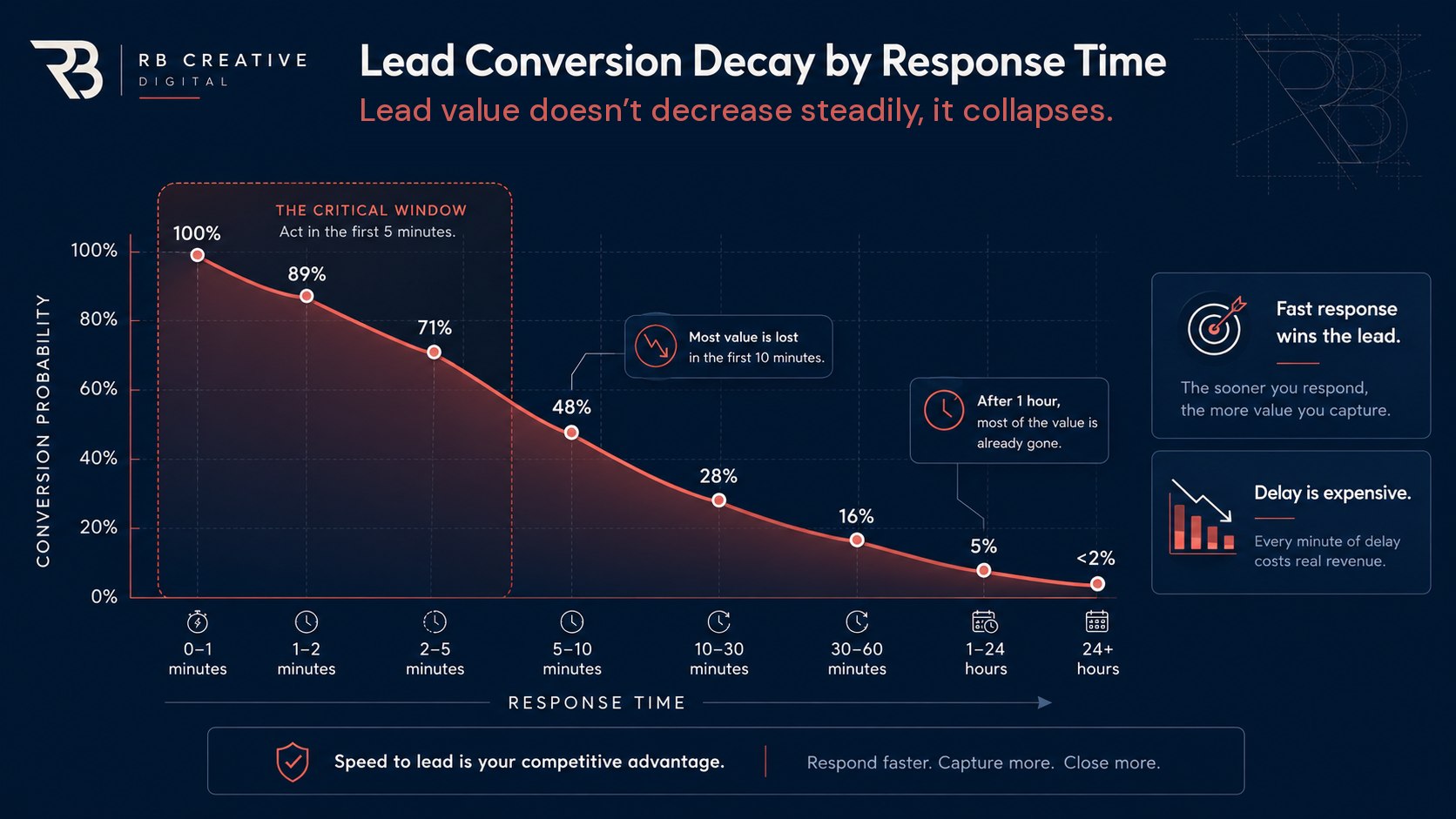
Because a lead is a person with a decision to make, right now. When someone fills in your form, they have usually filled in two or three others as well. Whoever replies first gets the first real conversation, and very often that is the conversation that wins the work.
Interest also cools quickly. An hour later they are back in meetings. A day later they have spoken to someone else. Two days later they have forgotten your name. The lead did not go bad. It went to whoever answered.
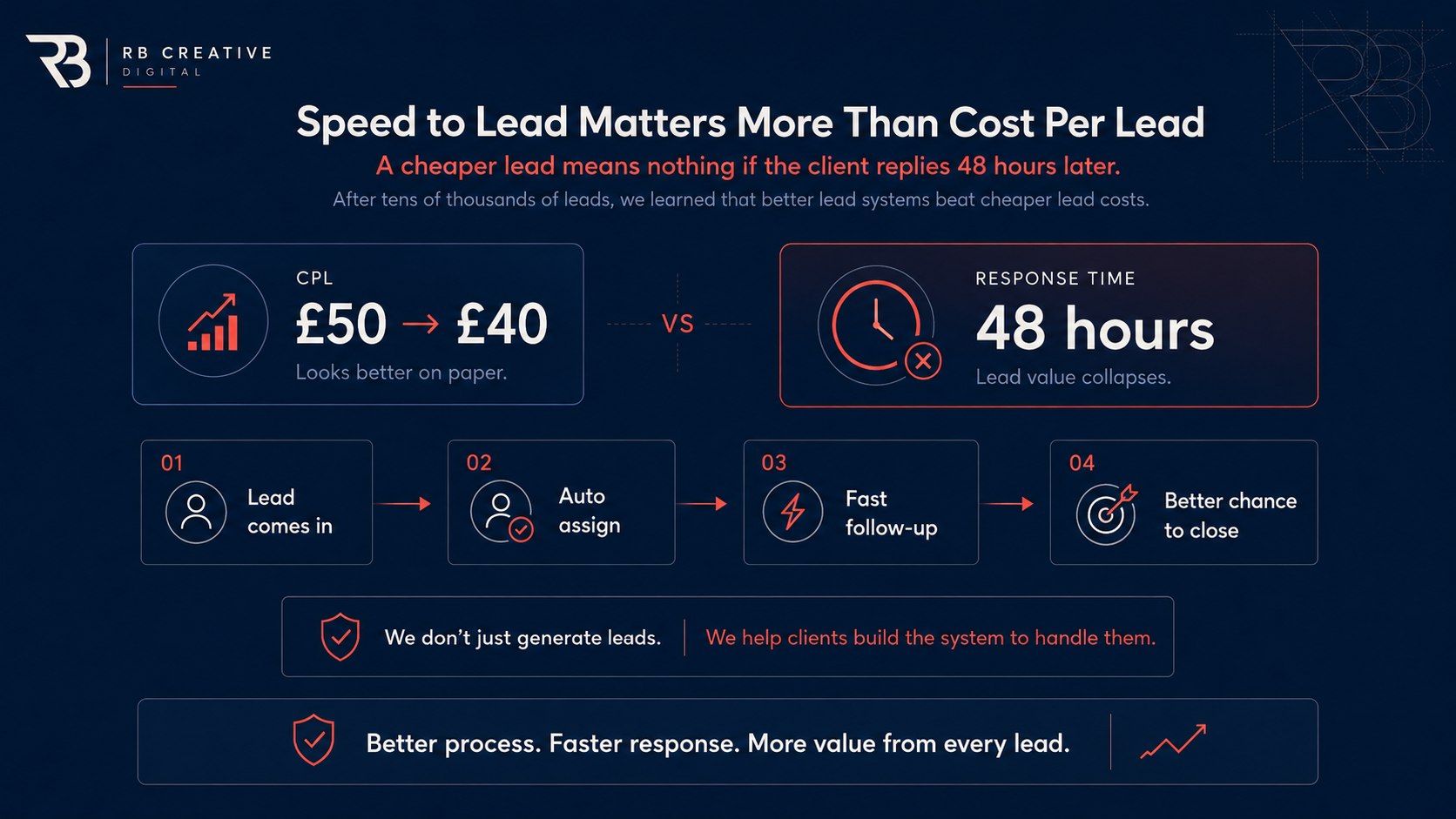
That is why cost per lead on its own is a misleading number. Paying less for a lead means nothing if it sits in an inbox for 48 hours. Speed decides how much of every lead you actually keep.
What system do you need in place?
Speed is not a personality trait. It is a set of simple steps that run every time a lead arrives, whether or not anyone remembers. Here is the setup I put in place for clients. None of it needs a big platform, and I have deliberately left out invented conversion percentages, because I do not have honest numbers for your business and neither does anyone selling you a dashboard.
- Get an instant ping the second a form comes in. The moment a lead hits your form, fire a notification to your own phone. A WhatsApp utility message on the official Cloud API costs, per Meta's own pricing, somewhere between 0.004 and 0.0456 USD per delivered message depending on country. Notifying yourself costs a rounding error. Email works as a free backup. The point is that you find out in seconds, not when you next happen to check an inbox.
- Make one person responsible for every lead. When a lead comes in, it should be clear who replies, automatically, without anyone having to decide. Leads shared with "the team" are leads nobody answers.
- Promise a same business day response and mean it. One line next to the form. It sets expectations, it is honest, and it quietly outperforms the brokers who promise nothing or promise the impossible.
- Keep a simple lead log with statuses. New, Contacted, Offer, Won, Lost. That is the whole system. Most leads do not vanish because you were slow by ninety seconds, they vanish because nobody ever wrote them down and one fell behind the others. A plain log fixes that, and it doubles as your record of who still needs chasing.
- Follow up on day one and day three if there is no answer. First contact rarely closes anything. A short, human nudge the next day and again two days later catches the people who were busy, not uninterested. This is where light marketing automation earns its keep: a small scheduler reads your log and reminds you, or sends the follow up for you.
That is the whole system: you know about the lead in seconds, someone owns it, they reply fast, and nothing slips through. If you want the wider context for how this sits inside acquisition, I have written separately about lead generation strategies that feed this exact process.
How fast is fast enough?
As fast as you can make it. During working hours, with an instant alert on your phone, a reply within minutes is realistic, and that is where you win the most.
What matters just as much is that you never fall off a cliff. Evenings and weekends happen, and that is exactly when a lot of enquiries land. So set a floor you always keep: every lead gets a reply the same business day, no exceptions, and put that promise in writing next to your form.
Fast whenever you can, never slower than the floor. That is a standard a small team can actually keep, and keeping it every single time is what wins.
How do you put this live without getting fancy?
Start with the two cheapest moves: add the same day promise to your form today, and wire up a notification to your phone this week. Those two alone change how fast you react, and they cost almost nothing. The lead log and the day one and day three follow ups come next, once you can see every enquiry in one place. Build it in that order and you get most of the upside of "speed to lead" without paying for the mythology around it. If you want a hand setting the notification and follow up flow up properly, that is exactly the kind of unglamorous plumbing we do, so get in touch and we will map it to your setup.
A note on the famous speed to lead numbers
You have seen these three claims. Leads contacted within five minutes are supposedly 21 times more likely to qualify than leads contacted after 30 minutes. Only 7 percent of B2B companies respond inside that five minute window. The median B2B response time is around 42 hours. They get repeated so often they feel like laws of physics.
Here is the part nobody puts on the slide. Almost every version of these figures circulates through the blogs of companies that sell lead response software. The pages ranking for "speed to lead statistics" belong to vendors whose product is, conveniently, faster lead response. That does not make the numbers fake, but it does mean they travel without their receipts, and a stat with no primary source is a marketing asset, not evidence.
The 21x figure in particular traces back to a single piece of research. It was the Lead Response Management study, associated with InsideSales, and it reached a wide audience through a 2011 Harvard Business Review article called The Short Life of Online Sales Leads by James Oldroyd, Kristina McElheran and David Elkington. Read that carefully: the study that half the internet still cites in 2026 was popularised in 2011. Buyer behaviour, phones, forms and expectations have all moved since then. When you see the same numbers recycled on vendor roundups and benchmark posts, you are usually looking at the same old study wearing a fresh date.
What can you safely believe, then?
The direction. Every source agrees on it, and so does plain common sense: a borrower who fills in a form is comparing you against two or three other brokers at that exact moment, and the one who replies while the intent is hot has an enormous advantage. You do not need a contested multiplier to believe that a same day reply beats a reply three days later. You have lived it. So have I.
What I will not do, and what I would advise you not to do either, is print "respond in five minutes and you are 21 times more likely to win" on your website as if it were a settled fact. If a competitor or a compliance officer asks you to back that up, you cannot, because the trail runs into a decade old study and a wall of vendor blogs. Use the idea, drop the fake precision. This is the same honesty filter I apply to everything I write about chasing mortgage leads: assert the direction, never invent the decimal.
What is a slow response costing you? Run your own numbers
Vendor calculators bake their own multipliers into the math and hand you a seven figure "opportunity". This one does not. Every number below is yours: your leads, your close rate, your average commission, and your own honest guess at how many more leads you would reach by answering faster. The formula is printed under the result, so you can check it on paper.
Formula, nothing hidden: leads x reach % x close rate % x average commission. The only assumption is the reach improvement, and you set it yourself.
No baked-in 21x, no 95% contact rate promises. If your honest inputs show a small number, that is a real answer too: your bottleneck is somewhere else.
Frequently asked questions
Is the 21x speed to lead statistic true?
It points in the right direction but should not be treated as fact. It traces to the Lead Response Management study popularised by a 2011 Harvard Business Review article, and it now circulates mainly through blogs of companies selling lead response software. Faster is better is safe to say. The exact multiplier is not verifiable for your business.
How fast should you respond to a new lead?
As fast as you can. With an instant alert on your phone, a reply within minutes is realistic during working hours, and that is where most deals are won. Set a floor you never break: every lead gets a reply the same business day, including evenings and weekends.
Does instant lead notification cost a lot to set up?
No. Notifying your own phone the moment a form arrives is close to free. A WhatsApp utility message on Meta's official Cloud API costs between 0.004 and 0.0456 USD per delivered message depending on country, and email works as a free backup. The value is knowing in seconds rather than hours.
Do I need expensive software to improve my lead response?
Not for a small brokerage. A same day promise, an instant phone notification, a simple lead log with statuses, and follow ups on day one and day three cover most of the benefit. Reach for a bigger platform only when your lead volume genuinely outgrows a log you can read at a glance.

Founder & CEO of RB Creative Digital. Nearly two decades in SEO and digital marketing for mortgage, aviation and AI-first companies, with clients in the UK, US and Romania. His work has been featured on Forbes, Entrepreneur and HuffPost.
LinkedIn · All articles by Radu
Edited and designed by Marius Stefan · Reviewed by Cristina Gabriela
Turn fast replies into signed mortgage deals
You do not need five minute theatre or a five figure platform. You need instant notifications, a same day promise you can keep, and a follow up flow that runs itself. That is the boring plumbing we set up for brokers every week. Tell us how your leads come in and we will map a plan to it.
Get your AI visibility check