
A personal note before the breakdown. Over the last six months my team and I have implemented AI and Bing optimization on more than 500 websites, and the results have been remarkable. That work is exactly why Microsoft's document caught my attention: it confirms, in writing, the playbook we have been running at scale. Here is what it says and what you should do with it.
What did Microsoft actually publish?
Microsoft released a document titled "Optimizing Your Content for Inclusion in AI Search Answers", their official guidance for content that appears inside AI-generated answers on Copilot, Bing AI and ChatGPT.
The opening line sets the tone:
"Whether you call it GEO, AIO, or SEO, one thing hasn't changed: visibility is everything."
Microsoft then states it plainly: "Traditional SEO fundamentals still matter. Crawlability, metadata, internal linking, and backlinks remain essential for ensuring your content is discoverable. But they're just the starting point."
In other words, the practices the industry is now rebranding as AI optimization are the same fundamentals experienced SEOs have applied for two decades. What has changed is where the results appear.
What does Microsoft recommend, exactly?
Here is Microsoft's guidance side by side with what the SEO industry has called the same practice for years:
| Microsoft's recommendation | What SEOs have called it | Since |
|---|---|---|
| Structure content with clear H2/H3 headings that "act like chapter titles" | Heading hierarchy | ~2008 |
| Clear titles, descriptions and H1s aligned with search intent | On-page SEO | ~2010 |
| Q&A formats that AI "can lift word for word into answers" | Featured snippet optimization | ~2016 |
| Schema markup that "turns plain text into structured data" | Structured data (Schema.org) | 2011 |
| Lists and tables that "break details into reusable segments" | Scannable formatting | ~2015 |
| Write for intent, not just keywords, with clear context | Semantic SEO (post-Hummingbird) | 2013 |
| Concise, self-contained "snippable" answers | Answer box optimization | ~2017 |
| Mobile optimization and page speed as baseline | Mobile-first indexing, Core Web Vitals | 2016 |
What is actually different in AI search?
One thing: the selection process. Microsoft explains that in traditional search, visibility meant appearing in a ranked list of links. In AI search, ranking still happens, but it is less about ordering entire pages and more about which pieces of content earn a place in the final answer.
- Traditional search: your page ranks, the user clicks through.
- AI search: your content gets cited inside the AI answer, and the user may click through.
The stakes are real. Research from Digital Applied found that sources cited in AI Overviews saw 2.3x traffic increases through branded searches, and Single Grain reported AI Overviews appearing in 52% of searches as of February 2025. The interface changed. The strategy that earns a citation did not.
So is AI optimization just good SEO?
Largely, yes. Google's official guidance on AI search says: "Focus on your visitors and provide them with unique, satisfying content. Then you should be well positioned as Google Search evolves." E-E-A-T, Google's quality framework since 2018, remains the foundation of AI visibility.
There is one addition most guides miss, and it is the reason we treat Bing as the lever for AI visibility: ChatGPT and Copilot pull web results from Bing's index, not Google's. A site that ranks well on Google but is poorly indexed in Bing can be invisible in ChatGPT answers. Bing Webmaster Tools setup and IndexNow are the first things we check for every client.
What should you do now?
The checklist below is what Microsoft recommends and what we implement for clients:
Content structure
- Clear H1 to H6 hierarchy, with H2s phrased as the questions people actually ask
- A TL;DR that answers the primary query in 50 to 70 words at the top
- Self-contained answers of 40 to 70 words that AI can quote directly
- Lists and comparison tables for anything with more than two options
Technical
- Article, FAQPage, Organization and Breadcrumb schema
- Clean crawlable architecture, fast mobile pages, correct metadata
- Bing Webmaster Tools verified, sitemap submitted, IndexNow active
Authority
- Visible author with real credentials on every article
- Citations to primary sources, and content kept fresh with update dates
New metrics to track
- Citation frequency in AI answers
- Referral traffic from AI tools in analytics
- Brand mention volume, because AI often cites without linking
Frequently asked questions
Do I need a separate AI SEO strategy?
No. Microsoft's own guidelines state that traditional SEO fundamentals remain essential and are the starting point for AI visibility. If an agency pitches you "AI optimization", ask what exactly they will do differently from proper SEO. The honest answer is usually: not much.
Why does Bing matter for ChatGPT visibility?
ChatGPT and Microsoft Copilot pull web results from Bing's index. Correct Bing Webmaster Tools setup and indexing give your content a direct path into AI answers, independent of your Google rankings.
How do I measure AI search visibility?
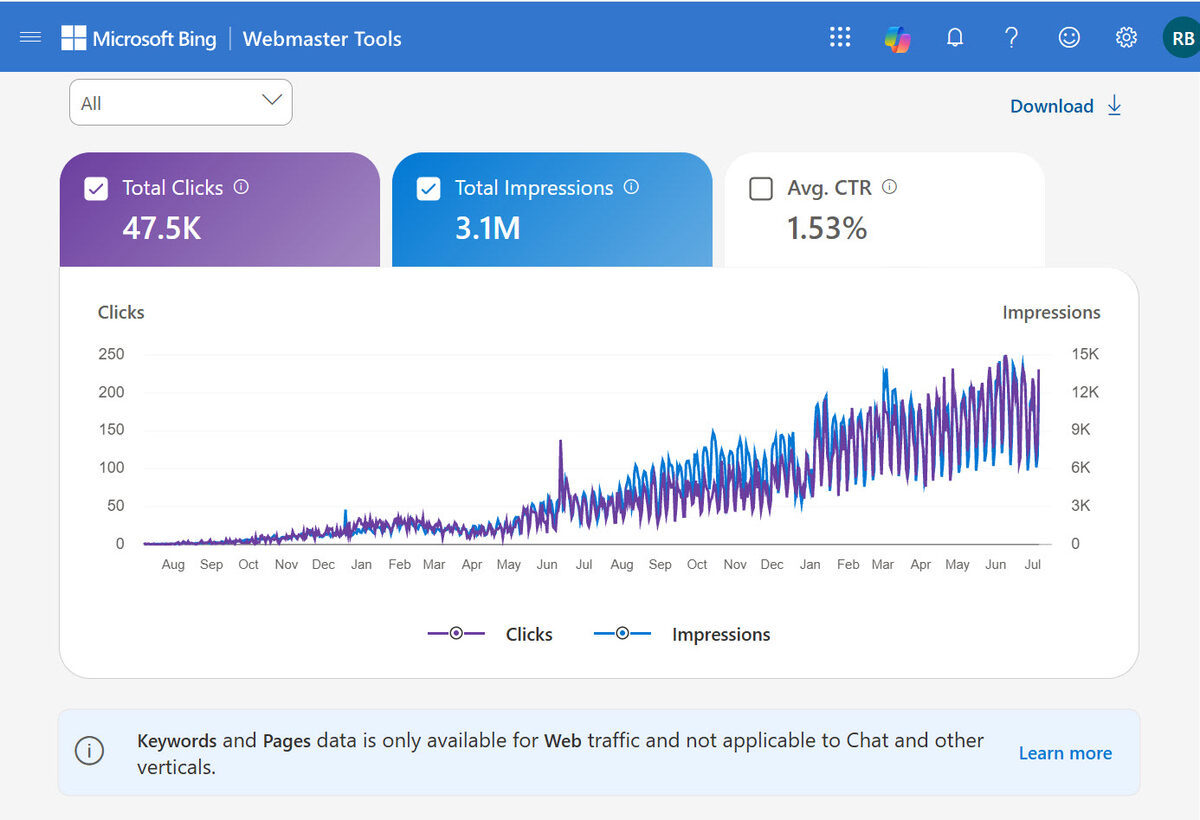
Track citation frequency in AI answers, referral traffic from AI tools in your analytics, and brand mention volume. For one aviation client we measured 372,200 AI citations in 3 months, alongside 2.1M Bing impressions and 30,500 clicks.
What is snippable content?
Self-contained answers of roughly 40 to 70 words that address one question directly. AI systems extract these pieces word for word and weave them into generated answers, which is exactly how content earns citations.

Founder & CEO of RB Creative Digital. Nearly two decades in SEO and digital marketing for mortgage, aviation and AI-first companies, with clients in the UK, US and Romania. His work has been featured on Forbes, Entrepreneur and HuffPost.
LinkedIn · All articles by Radu
Edited and designed by Marius Stefan · Reviewed by Cristina Gabriela
Does your business show up in ChatGPT?
We check Bing indexing, AI citations and the technical foundations, then tell you exactly where you stand. We usually reply within 1 hour.
Get your AI visibility check